
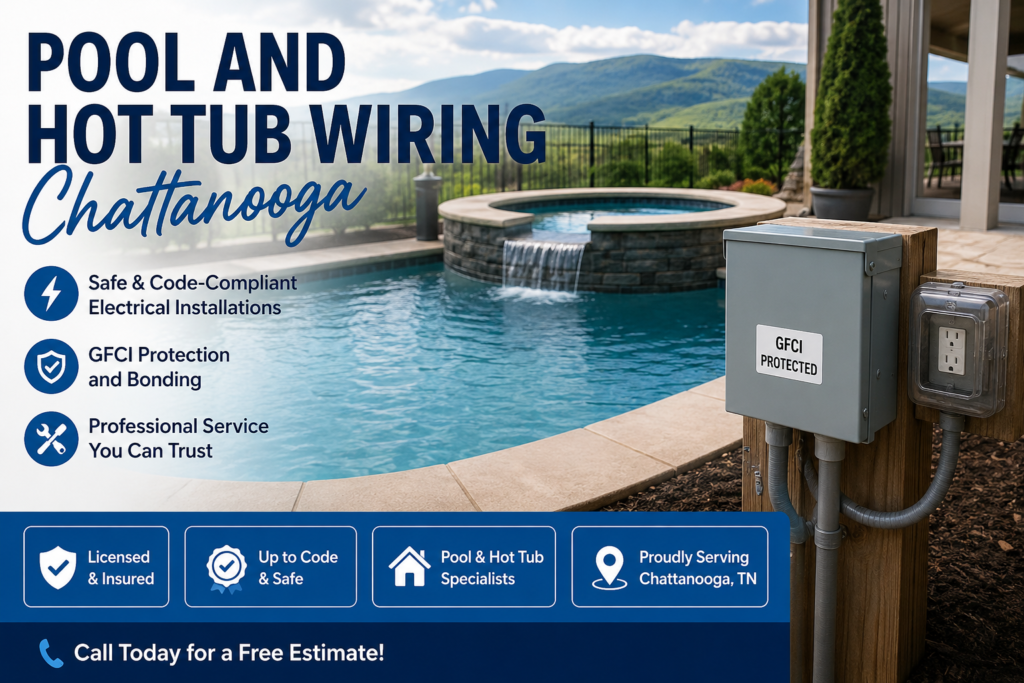
Why Pool and Hot Tub Wiring Is the Most Critical Electrical Work in Your Chattanooga Home
Installing a swimming pool or hot tub in your Chattanooga-area home is one of the most exciting upgrades you can make — but behind the relaxation and luxury lies one of the most dangerous and complex electrical projects a homeowner can undertake. Pool and hot tub wiring isn’t just about running a line from your panel to your equipment; it involves life-or-death safety considerations, strict National Electrical Code (NEC) requirements, and local jurisdiction rules that vary depending on whether you live in Chattanooga city (374xx), Ringgold, GA (30736), Collegedale, TN (37304), or Bryant, AL (35958).
In this ultimate guide, we’ll cover everything Chattanooga-area homeowners need to know about pool wiring, hot tub wiring, spa electrical installation, GFCI protection, bonding, grounding, permit requirements, costs, and code compliance — specifically tailored for every ZIP code in the Chattanooga metropolitan area. Whether you’re in 37401 (Downtown Chattanooga), 30750 (Lookout Mountain, GA), 37340 (Georgetown, TN), or 35966 (Flat Rock, AL), this guide ensures your pool or hot tub project is safe, legal, and built to last.
What Is Pool and Hot Tub Wiring? Understanding the Basics
Pool and hot tub wiring refers to the complete electrical system that powers all components of your swimming pool or spa installation. This isn’t a single wire — it’s an entire electrical ecosystem that includes:
Components of a Pool/Hot Tub Electrical System
| Component | Function | Electrical Requirements |
|---|---|---|
| Main Power Feed | Primary power from panel to equipment pad | 50-amp, 240V dedicated circuit (typical) |
| Pump Motor | Circulates water through filter and heater | 115V or 230V, 15-20 amp |
| Heater | Electric or gas with electric ignition | 240V, 30-60 amp (electric) or 120V (gas ignition) |
| Control Panel/Timer | Automates pump and heater cycles | 120V or 240V depending on system |
| Lighting (Underwater) | Pool/spa lights for safety and ambiance | 12V low-voltage (required by code) |
| Lighting (Area) | Deck lights, post lights, pathway lights | 120V, GFCI-protected |
| GFCI Protection | Ground Fault Circuit Interrupter — life safety | Required on ALL pool-related circuits |
| Bonding Grid | Equalizes electrical potential around pool | Required by NEC — copper wire mesh |
| Grounding System | Directs fault current safely to earth | Required on all metal components |
Why Pool and Hot Tub Wiring Is Different from Regular Electrical Work
Unlike installing a ceiling fan or adding an outlet, pool and hot tub wiring involves water — and water + electricity = lethal risk. The NEC dedicates Article 680 entirely to swimming pools, fountains, and similar installations. Key differences include:
- GFCI is mandatory on every circuit within 20 feet of the pool edge
- Bonding is required — all metal within 5 feet must be electrically connected
- Underground wiring has special depth and conduit requirements
- Equipotential planes prevent voltage gradients that can cause electrocution
- Permits and inspections are absolutely non-negotiable
- Only licensed electricians can legally perform this work
NEC Article 680: The Code That Governs Your Pool or Hot Tub in Chattanooga
The National Electrical Code (NEC) Article 680 is the bible for pool and hot tub electrical installations. Every jurisdiction in the Chattanooga metro area — from Hamilton County, TN to Catoosa County, GA to Jackson County, AL — has adopted some version of this code. Here’s what it mandates:
GFCI Requirements (The Non-Negotiable Life-Saver)
GFCI (Ground Fault Circuit Interrupter) protection is required for:
- All underwater lighting fixtures (must be 12V or less)
- All pool pump motors (regardless of voltage)
- All convenience outlets within 20 feet of the pool edge
- All lighting fixtures within 20 feet of the pool edge
- Hot tub/spa heaters and control systems
- Any equipment used with the pool (cleaners, covers, etc.)
GFCI works by detecting current leakage — as little as 4-6 milliamps — and shutting off power in 1/40th of a second. This is the difference between life and death in a pool environment.
Bonding Requirements: Why Your Pool Needs a Copper Grid
Bonding is one of the most misunderstood — and most critical — aspects of pool wiring. It means connecting all metal components within 5 feet of the pool with a solid copper conductor (minimum #8 AWG):
- Pool walls (metal or rebar in concrete)
- Ladder and handrail anchors
- Light niches
- Equipment pad (pump, filter, heater)
- Deck junction boxes
- Fences with metal within 5 feet
- Metal water pipes
Why bonding matters: Without it, if a fault occurs in one piece of equipment, the voltage can travel through the water and electrocute anyone touching a different metal component. Bonding equalizes voltage potential so everything rises and falls together — eliminating dangerous shocks.
Underground Wiring Requirements
For buried wiring to pool equipment:
- Rigid metal conduit or PVC required (direct burial cable prohibited in many jurisdictions)
- Minimum depth: 18 inches for conduit, 6 inches for rigid metal
- Separation from other utilities required
- Warning tape above conduit recommended
Distance Requirements
- Receptacles: No closer than 6 feet from pool edge, no farther than 20 feet (to allow vacuum use)
- Lighting fixtures: No closer than 12 feet from pool edge (unless specifically rated for closer)
- Overhead wiring: Minimum 22.5 feet clearance above pool surface
Pool and Hot Tub Wiring Costs in Chattanooga: Complete 2026 Price Guide
Installing pool and hot tub wiring in the Chattanooga metro area involves significant investment — but cutting corners is literally deadly. Here’s the complete cost breakdown for 2026:
Hot Tub / Spa Wiring Costs
| Service | Low Cost | High Cost | Average | Notes |
|---|---|---|---|---|
| Basic Hot Tub Wiring (120V plug-and-play) | $500 | $800 | $650 | Small tubs, limited features |
| Standard Hot Tub Wiring (240V, 50-amp) | $800 | $1,500 | $1,100 | Most common installation |
| Premium Hot Tub Wiring (240V, 60-amp + features) | $1,200 | $2,500 | $1,800 | Large tubs, multiple pumps |
| Hot Tub GFCI Sub-Panel | $300 | $600 | $450 | Required for most installations |
| Hot Tub Concrete Pad + Wiring | $1,500 | $3,000 | $2,200 | Includes pad and electrical |
| Hot Tub Relocation / Rewire | $600 | $1,200 | $900 | Moving existing tub to new location |
Swimming Pool Wiring Costs
| Service | Low Cost | High Cost | Average | Notes |
|---|---|---|---|---|
| Basic Pool Wiring (above-ground, single pump) | $1,200 | $2,500 | $1,800 | Simple setup |
| In-Ground Pool Wiring (standard) | $2,500 | $5,000 | $3,700 | Pump, light, heater, controls |
| In-Ground Pool Wiring (premium) | $4,000 | $8,000 | $6,000 | Multiple lights, automation, heater |
| Pool Pump Circuit Only | $700 | $1,200 | $950 | Dedicated 20-30 amp circuit |
| Pool Heater Wiring (electric) | $1,000 | $2,000 | $1,500 | 240V, 30-60 amp |
| Pool Light Wiring (underwater LED) | $400 | $800 | $600 | 12V low-voltage system |
| Pool Automation/Control System | $1,500 | $3,500 | $2,500 | Smart controls, timers, remote |
| Pool Bonding Grid Installation | $800 | $1,500 | $1,100 | Required by NEC |
| Pool GFCI Panel Upgrade | $500 | $1,200 | $850 | If main panel lacks space |
| Complete Pool Electrical (new construction) | $3,000 | $7,000 | $5,000 | Full system from scratch |
Additional Costs to Consider
| Item | Cost | When Needed |
|---|---|---|
| Electrical Panel Upgrade | $1,500 – $3,000 | If panel lacks capacity or space |
| Trenching / Excavation | $500 – $2,000 | For underground conduit runs |
| Permit Fees | $100 – $500 | Varies by ZIP code/jurisdiction |
| Inspection Fees | $100 – $300 | Required in all jurisdictions |
| GFCI Breakers | $50 – $150 each | Required for each pool circuit |
| Conduit and Wire | $200 – $800 | Depending on distance from panel |
| Bonding Wire and Clamps | $150 – $400 | Required copper #8 AWG minimum |
Cost Variations by Chattanooga ZIP Code
Costs can vary slightly depending on your location:
- 37401-37403 (Downtown Chattanooga): Higher labor rates ($85-$120/hr), limited access, parking challenges
- 37404-37410 (South/East Chattanooga): Older homes may need panel upgrades first (+$1,500-$3,000)
- 37411-37412 (East Ridge): Standard rates, mix of housing ages
- 37415 (North Chattanooga/Red Bank): Standard rates, newer homes easier to wire
- 30736 (Ringgold, GA): Growing area, competitive pricing, many new pools being installed
- 30741 (Rossville, GA) & 30742 (Fort Oglethorpe, GA): Standard GA rates, slightly lower than downtown Chattanooga
- 30750 (Lookout Mountain, GA): Upscale area, premium pricing, complex terrain
- 37304 (Collegedale, TN): Suburban rates, many new construction pools
- 37308, 37315, 37340, 37384, 37396 (Rural TN): May include travel charges, trenching costs higher
- 35746, 35958, 35966 (North AL): Lower cost of living = lower labor rates
- 30725, 30752, 30757 (Rural GA): Travel charges possible, rural property considerations
Permits and Inspections: What Every Chattanooga Homeowner Must Know
You cannot legally install pool or hot tub wiring without permits and inspections. Period. Every jurisdiction in our service area requires this:
Chattanooga City (ZIP Codes: 37401, 37402, 37403, 37404, 37407, 37408, 37409, 37410, 37411, 37412, 37414, 37415)
- Permit required: Yes — Building & Electrical Permit
- Issued by: Chattanooga Department of Public Works
- Inspections required:
- Rough-in inspection (before covering conduit/wires)
- Final inspection (after equipment installed)
- Bonding inspection (specific to pools)
- Timeline: Permit issued within 3-5 business days; inspections within 48 hours of request
- Cost: $100-$400 depending on project scope
- Licensed electrician required: Yes, must hold City of Chattanooga electrical license
Hamilton County, TN (Unincorporated: 37416, 37419, 37421, 37304, 37308)
- Permit required: Yes
- Issued by: Hamilton County Building Inspections
- Inspections: Rough-in and final
- Licensed electrician required: Yes, Tennessee state license
- Special notes: Well water properties may need additional coordination
Catoosa County, GA (30736, 30741, 30742)
- Permit required: Yes
- Issued by: Catoosa County Building Department
- Inspections: Rough-in and final
- Licensed electrician required: Yes, Georgia state license
- Special notes: Georgia has specific GFCI requirements that differ slightly from TN
Walker County, GA (30725, 30750)
- Permit required: Yes
- Issued by: Walker County Building Department
- Inspections: Two-stage inspection process
- Licensed electrician required: Yes, Georgia state license
Dade County, GA (30752, 30757)
- Permit required: Yes
- Issued by: Dade County Building Department
- Inspections: Required
- Licensed electrician required: Yes, Georgia state license
Jackson County, AL (35746, 35958, 35966)
- Permit required: Yes
- Issued by: Jackson County Building Department
- Inspections: Required
- Licensed electrician required: Yes, Alabama state license
- Special notes: Alabama NEC adoption may have local amendments
ZIP Code by ZIP Code: Pool and Hot Tub Wiring Services Near You
We provide licensed, insured pool and hot tub wiring services across every ZIP code in the Chattanooga metro area. Here’s what homeowners in each area need to know:
Downtown Chattanooga (37401, 37402, 37403)
Neighborhoods: Downtown, North Shore, UTC Area, Riverfront
Pool/Hot Tub Considerations:
- Many homes are historic (pre-1950) with outdated electrical panels
- Panel upgrades often required before pool/hot tub installation (+$2,000-$3,500)
- Limited backyard space = above-ground pools and compact hot tubs more common
- Parking and access challenges for equipment delivery and trenching
- HOA restrictions common in condo buildings
Common Projects:
- Rooftop hot tub wiring (complex, requires structural engineering review)
- Balcony/patio hot tub installations
- Historic home panel upgrades + hot tub circuits
East and South Chattanooga (37404, 37407, 37408, 37410)
Neighborhoods: East Chattanooga, South Chattanooga, Alton Park, St. Elmo, Southside
Pool/Hot Tub Considerations:
- Older housing stock (1920s-1960s) with knob-and-tube or early Romex wiring
- Electrical service upgrades frequently needed (100-amp to 200-amp)
- Sump pump circuits often needed alongside pool wiring (basement flooding risk)
- Budget-conscious homeowners — we offer financing options
- Community pools being renovated with modern electrical systems
Common Projects:
- Above-ground pool wiring for family homes
- Hot tub installations on existing decks
- Complete electrical service upgrades for pool additions
East Ridge (37411, 37412)
Neighborhoods: East Ridge (TN side), border with GA
Pool/Hot Tub Considerations:
- Suburban mix of 1960s-1990s homes
- Many homes already have 200-amp service
- GA border proximity means some homeowners work with GA-licensed contractors
- Moderate lot sizes suitable for in-ground pools
- Family-oriented area — pools very popular
Common Projects:
- In-ground pool electrical systems
- Hot tub additions to existing pools
- Pool house/outbuilding wiring
North Chattanooga / Red Bank (37415)
Neighborhoods: Red Bank, North Chattanooga, Hixson area
Pool/Hot Tub Considerations:
- Newer homes (1980s-2020s) with modern electrical systems
- Larger lots perfect for pool installations
- Hilly terrain may require creative trenching solutions
- Higher-end homes often request premium automation systems
- Good access for contractors
Common Projects:
- Premium in-ground pool installations
- Smart pool automation systems
- Outdoor kitchen + pool combo wiring
- Hot tub installations with landscape lighting
Collegedale (37304)
Neighborhoods: Collegedale, Ooltewah area
Pool/Hot Tub Considerations:
- Rapid growth area — many new construction homes
- Southern Adventist University presence = rental properties with hot tubs
- Newer electrical panels in most homes = easier installations
- Suburban family community = high demand for pools
- Competitive pricing due to many contractors serving area
Common Projects:
- New construction pool wiring
- Subdivision pool electrical work
- Rental property hot tub installations
- Community pool maintenance and upgrades
Ringgold, GA (30736)
Neighborhoods: Ringgold, Catoosa Springs
Pool/Hot Tub Considerations:
- Fastest-growing area in Chattanooga metro
- New subdivisions with modern infrastructure
- Georgia electrical code applies — different permit process than TN
- Family-oriented community = pool demand very high
- Competitive contractor market = good pricing
Common Projects:
- New in-ground pool electrical systems
- Subdivision community pools
- Hot tub installations in new homes
- Pool automation and smart controls
Rossville, GA (30741) & Fort Oglethorpe, GA (30742)
Neighborhoods: Rossville, Fort Oglethorpe, Lakeview
Pool/Hot Tub Considerations:
- Close to Chattanooga border = easy access for TN and GA contractors
- Mix of older and newer homes
- Fort Oglethorpe historic district = special considerations for visible wiring
- Moderate pricing
- Good lot sizes for pool installations
Common Projects:
- Residential pool wiring
- Hot tub deck installations
- Pool heater additions to existing pools
Lookout Mountain, GA (30750) & Lookout Mountain, TN (37419, 37450)
Neighborhoods: Lookout Mountain (GA and TN sides)
Pool/Hot Tub Considerations:
- Upscale, historic area
- Premium pricing for all services
- Rocky terrain = difficult trenching, higher excavation costs
- Historic homes = frequent panel upgrades needed
- Scenic views = pools often positioned for maximum visibility = longer wire runs
Common Projects:
- Luxury pool electrical systems
- Historic home panel upgrades + pool wiring
- Premium hot tub installations with landscape integration
- Smart home + pool automation combos
Rural Tennessee (37308, 37315, 37340, 37384, 37396)
Neighborhoods: Birchwood, Charleston, Georgetown, South Pittsburg, Whiteside
Pool/Hot Tub Considerations:
- Rural properties = larger lots, more pool options
- Well water systems = may need dedicated pump circuits alongside pool wiring
- Septic systems = careful coordination for equipment pad placement
- Longer distances from electrical panel to pool = higher wire/conduit costs
- Limited contractor availability = may include travel charges
Common Projects:
- Large in-ground pool installations
- Above-ground pool wiring for rural homes
- Hot tub + outdoor living space combos
- Agricultural pool/water feature wiring
Rural Georgia (30725, 30752, 30757)
Neighborhoods: Flintstone, Trenton, Wildwood
Pool/Hot Tub Considerations:
- Very rural = limited contractor base
- Mountainous terrain (Wildwood) = challenging installations
- Lower cost of living = lower labor rates
- Larger properties = expansive pool installations possible
- Travel charges may apply from Chattanooga-based contractors
Common Projects:
- Rural residential pool wiring
- Farm pond electrical systems
- Basic hot tub installations
North Alabama (35746, 35958, 35966)
Neighborhoods: Bridgeport, Bryant, Flat Rock
Pool/Hot Tub Considerations:
- Alabama electrical code with local amendments
- Small communities = limited local contractors
- Riverfront properties (Bridgeport) = special grounding considerations
- Lower pricing than TN or GA
- Travel from Chattanooga contractors = possible travel fees
Common Projects:
- Basic residential pool and hot tub wiring
- Riverfront property electrical safety upgrades
Hot Tub Wiring: The Step-by-Step Process for Chattanooga Homeowners
Understanding the installation process helps you ask the right questions and ensures your contractor is following proper procedures. Here’s how professional hot tub wiring works in the Chattanooga area:
Step 1: Site Assessment and Load Calculation (Day 1)
Your licensed electrician will:
- Assess your existing electrical panel for available space and capacity
- Calculate the total electrical load of your hot tub (pump + heater + blower + lights + controls)
- Determine the distance from panel to hot tub location
- Identify obstacles (driveways, sidewalks, landscaping, utilities)
- Check local code requirements for your specific ZIP code
- Provide a written estimate with permit costs included
Typical hot tub electrical load:
- Small tub (120V): 1,500 watts
- Standard tub (240V): 5,500-7,500 watts
- Large tub (240V): 7,500-11,000 watts
- Premium tub (240V): 11,000+ watts
Step 2: Permit Application (Day 2-5)
Your electrician will:
- Submit electrical permit application to your local jurisdiction
- Include load calculations and site plans
- Pay permit fees ($100-$500 depending on ZIP code)
- Schedule inspection appointments for rough-in and final
Permit timeline by jurisdiction:
- Chattanooga City: 3-5 business days
- Hamilton County: 3-5 business days
- Catoosa County, GA: 5-7 business days
- Walker/Dade County, GA: 5-10 business days
- Jackson County, AL: 5-10 business days
Step 3: Panel Preparation (Day 5-7)
Before running wires:
- Install dedicated GFCI breaker in main panel (50-amp typical for 240V tubs)
- If panel lacks space, install sub-panel or upgrade main panel
- Verify grounding system is adequate (required for GFCI function)
- Test existing circuits for proper function
Step 4: Conduit and Wire Installation — Rough-In (Day 7-10)
This is the rough-in phase (must be inspected before covering):
- Trench from panel to hot tub location (18 inches minimum depth for PVC conduit)
- Lay PVC conduit (¾ inch or 1 inch typical)
- Pull wire through conduit (6 AWG for 50-amp, 8 AWG for 40-amp)
- Install junction box near hot tub location
- Install GFCI disconnect within sight of hot tub (required by code — must be visible from tub location)
- Install bonding wire if metal components within 5 feet
Wire requirements for hot tubs:
- 50-amp circuit: 6 AWG copper wire (3 conductors + ground)
- 60-amp circuit: 4 AWG copper wire
- All wire must be THHN/THWN-2 rated for wet locations
- Conduit required — direct burial cable prohibited in most jurisdictions
Step 5: Rough-In Inspection (Day 10-12)
The inspector will verify:
- Conduit depth and placement
- Wire size matches breaker rating
- GFCI breaker properly installed
- Disconnect location visible from tub
- Bonding connections (if applicable)
- Panel labeling and circuit identification
If inspection fails: Corrections must be made and re-inspected before proceeding.
Step 6: Hot Tub Delivery and Connection (Day 12-15)
After rough-in passes inspection:
- Hot tub delivered and placed on pad/deck
- Electrical connection made to junction box
- Control panel wired and programmed
- GFCI testing performed
- Bonding verification completed
Step 7: Final Inspection and Testing (Day 15-18)
Final inspection verifies:
- All connections properly made
- GFCI function tested (trip test)
- Grounding verified with megohmmeter
- Bonding continuity tested
- Operational test of all components (pump, heater, lights, controls)
- Code compliance in all aspects
Upon passing: Certificate of completion issued, permit closed.
Step 8: Ongoing Maintenance and Safety
- Test GFCI monthly using test/reset buttons
- Inspect cover and wiring annually
- Keep area around disconnect clear and accessible
- Never use extension cords with hot tub
- Schedule professional inspection every 3-5 years
Swimming Pool Wiring: Above-Ground vs. In-Ground Electrical Requirements
Pool wiring complexity varies dramatically based on pool type. Here’s the breakdown:
Above-Ground Pool Wiring
Electrical components:
- Pump/filter circuit: 20-amp, 120V dedicated circuit (or 240V for larger pumps)
- Lighting: 12V low-voltage underwater light (if installed)
- Area lighting: 120V GFCI-protected outlets and fixtures
- Heater: Optional, 240V dedicated circuit if electric
Cost range: $1,200 – $2,500 (average $1,800)
Key considerations:
- Pump typically sits at pool edge — short wire runs
- Ladder/handrails must be bonded if metal
- Deck around pool needs bonding if conductive surface
- Easier installation than in-ground but still requires full code compliance
Popular in ZIP codes: 37404, 37407, 37408, 37410, 30736, 37304, 37308, 37315, 37340 (budget-friendly areas and rural properties)
In-Ground Pool Wiring
Electrical components:
- Main pump circuit: 20-30 amp, 240V
- Secondary pump (spa, water features): 20 amp, 240V
- Heater: 30-60 amp, 240V (electric) or 120V (gas ignition)
- Underwater lights: 12V low-voltage, multiple fixtures
- Area lighting: 120V GFCI, multiple circuits
- Automation/control system: 120V or 240V
- Pool cover: 120V dedicated circuit
- Water features: Fountains, waterfalls, jets — separate circuits
Cost range: $2,500 – $7,000 (average $4,500)
Key considerations:
- Equipment pad location typically 10-20 feet from pool
- Longer conduit runs = higher material costs
- Bonding grid must encompass entire pool structure
- Rebar in concrete must be bonded
- Light niches require waterproof junction boxes
- Automation systems require low-voltage communication wiring
Popular in ZIP codes: 37401, 37402, 37403, 37411, 37412, 37415, 37421, 30736, 30750, 37304 (higher-end homes and new construction)
GFCI Protection: The Technology That Saves Lives in Chattanooga Pools
GFCI (Ground Fault Circuit Interrupter) is the single most important safety device for pool and hot tub electrical systems. Here’s everything you need to know:
How GFCI Works
GFCI monitors the electrical current flowing through the hot and neutral wires. In a normal circuit, these currents are equal. If even 4-6 milliamps of current “leaks” — meaning it’s going somewhere it shouldn’t (like through water or a person) — the GFCI detects the imbalance and shuts off power in 1/40th of a second.
To put this in perspective: 1 amp = 1,000 milliamps. A standard circuit breaker won’t trip until 15-20 amps flow — which is 3,000 times more current than a GFCI detects. By the time a standard breaker trips, you’re already dead. GFCI prevents electrocution before it happens.
GFCI Requirements for Pools and Hot Tubs (NEC 680)
| Component | GFCI Required | Type | Notes |
|---|---|---|---|
| Underwater lights | Yes | Class A (5mA) | Must be 12V or less |
| Pool pump motors | Yes | Class A (5mA) | All voltages, all sizes |
| Hot tub pump motors | Yes | Class A (5mA) | All voltages |
| Hot tub heaters | Yes | Class A (5mA) | Electric heaters |
| Hot tub controls | Yes | Class A (5mA) | Control panels |
| Convenience outlets | Yes | Class A (5mA) | Within 20 feet of pool |
| Area lighting | Yes | Class A (5mA) | Within 20 feet of pool |
| Pool cover motors | Yes | Class A (5mA) | Automatic covers |
| Pool cleaning equipment | Yes | Class A (5mA) | Robotic cleaners, etc. |
GFCI Breaker vs. GFCI Outlet vs. GFCI Disconnect
| Type | Best For | Cost | Location |
|---|---|---|---|
| GFCI Breaker | Main panel protection | $50-$150 | Electrical panel |
| GFCI Disconnect | Hot tub/pool equipment | $100-$300 | Near equipment pad |
| GFCI Outlet | Area lighting, convenience | $15-$30 | Within 20 feet of pool |
| GFCI Sub-Panel | Multiple pool circuits | $300-$600 | Equipment pad area |
For hot tubs: A GFCI disconnect within sight of the tub is required. This allows anyone to cut power in an emergency without running to the main panel.
For pools: GFCI breakers in the main panel + GFCI outlets for area lighting and convenience.
GFCI Testing: Your Monthly Lifesaving Habit
Every pool and hot tub owner should test GFCI protection monthly:
- Press the TEST button on the GFCI device
- Power should immediately cut off
- Press the RESET button
- Power should restore
- If GFCI doesn’t trip or reset — call an electrician immediately
GFCI devices have a lifespan of 10-15 years. If your pool or hot tub is older, consider proactive GFCI replacement.
Bonding and Grounding: The Invisible Safety Net for Your Pool
Many homeowners — and even some inexperienced electricians — confuse bonding and grounding. Both are essential, but they serve different purposes.
Grounding: The Path to Earth
Grounding provides a safe path for fault current to flow into the earth. If a wire inside a pump motor touches the metal case, grounding ensures the electricity flows to ground rather than through a person touching the pump.
Grounding requirements:
- All electrical equipment must be grounded
- Ground wire must be green or bare copper
- Ground wire size must match circuit conductors
- Ground connection must be continuous back to main panel
Bonding: The Equalizer
Bonding connects all metal components together so they all have the same electrical potential. If a fault occurs in one piece of equipment, the voltage rises equally on all bonded metal — so there’s no voltage difference between components. Without bonding, you could touch a ladder (at 0 volts) and a light niche (at 120 volts) simultaneously — and electricity flows through your body.
Bonding requirements (NEC 680.26):
- All metal within 5 feet of pool edge must be bonded
- Bonding wire must be solid copper, #8 AWG minimum
- Bonding connections must be accessible for inspection
- Bonding grid must include:
- Pool walls (rebar in concrete)
- Metal ladder and handrail anchors
- Light niches
- Equipment pad (pump, filter, heater)
- Deck junction boxes
- Metal water pipes
- Metal fences within 5 feet
- Metal structures within 5 feet
The Equipotential Plane
For concrete decks, NEC requires an equipotential plane — a grid of bonded rebar or copper wire within the deck surface. This prevents voltage gradients that can cause “step potential” shocks (where voltage differs between your feet).
Required for:
- All concrete decks poured after NEC 2008 adoption
- All metallic decks
- All decks with conductive surfaces
Not required for:
- Wood decks (if properly insulated)
- Non-conductive composite decks
Common Pool and Hot Tub Wiring Mistakes (And Why They Kill People)
Even in the Chattanooga area, we’ve seen dangerous installations — often from unlicensed contractors or DIY attempts. Here are the deadly mistakes:
Mistake #1: No GFCI Protection
What happens: Someone touches a faulty pump or light while in the water. Without GFCI, they receive a lethal shock.
Code requirement: GFCI on EVERY pool-related circuit. No exceptions.
Real-world consequence: Electrocution drowning — the victim is paralyzed by electricity and drowns, even in shallow water.
Mistake #2: No Bonding
What happens: A fault in the pump raises the equipment pad to 120 volts. The pool water is at 0 volts (grounded through other means). A swimmer touches the ladder (bonded to pad) and the water — electricity flows through their body.
Code requirement: Bonding of ALL metal within 5 feet.
Real-world consequence: Electric shock drowning — the victim is incapacitated and cannot swim to safety.
Mistake #3: Wrong Wire Type
What happens: Using standard indoor wire (NM-B/Romex) for underground pool runs. Moisture enters the wire, causes corrosion, creates resistance heating, and eventually causes a fire or fault.
Code requirement: Wet-location rated wire (THHN/THWN-2) in conduit.
Real-world consequence: Wire failure, fire, or shock hazard.
Mistake #4: No Permit or Inspection
What happens: Unlicensed installer skips permit to save money. Faulty work goes undetected. Insurance denies claim when accident occurs.
Code requirement: Permits and inspections for ALL pool electrical work.
Real-world consequence: Denied insurance claims, liability lawsuits, criminal charges if someone dies.
Mistake #5: Extension Cords
What happens: Homeowner uses extension cord for pool pump or hot tub. Cord gets damaged by water, sun, or foot traffic. Bare wires exposed.
Code requirement: NO extension cords for pool/hot tub equipment. Permanent wiring only.
Real-world consequence: Electrocution, fire.
Mistake #6: No Disconnect Within Sight
What happens: Emergency occurs in hot tub. Someone needs to cut power but has to run 50 feet to the main panel inside the house. By the time they get there, it’s too late.
Code requirement: Disconnect switch within sight of hot tub (and pool, in some jurisdictions).
Real-world consequence: Delayed emergency response, injury or death.
Choosing a Licensed Electrician for Pool and Hot Tub Wiring in Chattanooga
This is not a job for a handyman, a DIY enthusiast, or an unlicensed contractor. Pool and hot tub wiring requires specialized knowledge, specific licensing, and extensive experience. Here’s how to choose the right electrician in your ZIP code:
Required Qualifications
| Qualification | Why It Matters | How to Verify |
|---|---|---|
| State Electrical License | Legal requirement for all electrical work | Ask for license number, verify online |
| Local Jurisdiction License | Some cities require additional licensing | Chattanooga, Ringgold, etc. |
| Pool/Spa Electrical Experience | Specialized knowledge of NEC Article 680 | Ask for portfolio of pool projects |
| Insurance (General Liability) | Protects you if property is damaged | Request certificate of insurance |
| Workers’ Compensation | Protects you if worker is injured | Request certificate of insurance |
| Permit Handling | Ensures legal compliance | Ask if they pull permits |
| Warranty on Work | Ensures quality and accountability | Get written warranty |
Red Flags: Walk Away If You Hear These
🚩 “You don’t need a permit for this.”
🚩 “GFCI is optional for the pump.”
🚩 “Bonding isn’t necessary for above-ground pools.”
🚩 “I can do this cheaper without a license.”
🚩 “We can skip the inspection if you pay cash.”
🚩 “Extension cords are fine for temporary use.”
🚩 “I’ve never done a pool before, but wiring is wiring.”
Any of these statements indicates an unqualified, unlicensed, or dangerous contractor. Run away.
Questions to Ask Before Hiring
- “Are you licensed in [my specific ZIP code jurisdiction]?” — TN, GA, and AL have different requirements.
- “How many pool/hot tub wiring projects have you completed in the last year?” — Look for 10+ annually.
- “Will you pull the permit and schedule inspections?” — Answer must be yes.
- “What size GFCI breaker will you install?” — Should match tub/pool specifications exactly.
- “Will you install bonding for all metal components?” — Answer must be yes.
- “What type of wire and conduit will you use?” — THHN/THWN-2 in PVC conduit.
- “Where will the disconnect be located?” — Must be within sight of hot tub.
- “What’s your warranty?” — Minimum 1 year on workmanship.
- “Can you provide references from recent pool wiring projects?” — Check them.
- “What’s the total cost including permits and inspections?” — No hidden fees.
Top-Rated Pool and Hot Tub Electricians in Chattanooga Metro
While we can’t endorse specific contractors, here are the types of companies to look for in your ZIP code:
- Licensed in multiple states (TN, GA, AL) — important for metro area coverage
- 10+ years experience with pool and spa electrical
- NEC Article 680 certification or specialized training
- Strong local reputation with verifiable reviews
- Transparent pricing with written estimates
- Permit and inspection handling included in service
ZIP codes with the most pool/hot tub electricians: 37401, 37402, 37403, 37411, 37412, 37415, 37421, 30736, 30741, 30742, 37304
Pool and Hot Tub Automation: The Future of Chattanooga Backyard Living
Modern pool and hot tub systems go far beyond basic wiring. Smart automation is transforming how Chattanooga homeowners enjoy their outdoor spaces:
Smart Pool Control Systems
| Feature | Function | Electrical Requirement |
|---|---|---|
| Remote Control | Control pump, heater, lights from phone | WiFi connection + control panel |
| Variable Speed Pumps | Adjust flow rate for efficiency | 240V, variable frequency drive |
| Smart Heaters | Maintain precise temperature | 240V, 30-60 amp |
| LED Color Lighting | Programmable underwater lights | 12V low-voltage, multiple zones |
| Automatic Covers | Open/close with button press | 120V dedicated circuit |
| Water Chemistry Monitoring | Automated pH and chlorine | Low-voltage sensors + 120V pumps |
| Freeze Protection | Auto-run pump when temps drop | Integrated with control system |
| Voice Control | “Alexa, turn on pool lights” | Smart home integration |
Automation Costs
| System Level | Cost | Features |
|---|---|---|
| Basic Timer | $100-$300 | Simple on/off scheduling |
| Digital Control | $500-$1,500 | Multi-function scheduling, remote |
| Smart Automation | $1,500-$3,500 | Full remote control, variable speed, diagnostics |
| Premium Integration | $3,500-$7,000 | Voice control, smart home integration, AI optimization |
Popular in ZIP codes: 37401, 37402, 37403, 37415, 30736, 30750, 37304 (higher-end homes)
Seasonal Considerations for Pool and Hot Tub Wiring in Chattanooga
Chattanooga’s four-season climate creates unique challenges for pool and hot tub electrical systems:
Summer (June-August)
- Peak usage season — electrical systems work hardest
- Heat affects wire capacity — wires in conduit may need derating
- Thunderstorms — lightning protection important for automation systems
- High humidity — GFCI testing critical, moisture can cause nuisance tripping
ZIP codes most affected: All, but especially 37401-37415 (urban heat island effect)
Fall (September-November)
- Pool closing season — proper winterization of electrical components
- Leaf debris — keep GFCI outlets and disconnects clear
- Temperature swings — expansion/contraction of conduit and wire
Winter (December-February)
- Freeze protection — pumps must run continuously during hard freezes
- Ice damage — protect above-ground conduit from ice expansion
- Hot tub peak season — electrical systems under maximum load
ZIP codes most affected: 30750, 30752, 30757, 37308, 37315, 37340, 37384, 37396 (higher elevations, colder temperatures)
Spring (March-May)
- Pool opening season — inspect all electrical before first use
- Rain and moisture — test GFCI after heavy rains
- Pollen — can clog outdoor outlets and disconnects
Energy Efficiency: Saving Money on Pool and Hot Tub Electrical Costs
Pool and hot tubs are among the biggest energy users in a home. Here’s how to minimize costs:
Energy-Saving Strategies
| Strategy | Savings | Implementation |
|---|---|---|
| Variable Speed Pump | 40-80% on pump energy | Upgrade from single-speed pump |
| Timer Controls | 20-30% on overall energy | Run pump during off-peak hours |
| Solar Pool Heater | 100% on heating energy | Supplement or replace electric heater |
| Pool Cover | 50-70% on heating energy | Reduce evaporation and heat loss |
| LED Lighting | 80% on lighting energy | Replace incandescent pool lights |
| Proper Sizing | 10-20% on overall energy | Right-size pump and heater for pool |
| Insulated Hot Tub | 30-50% on heating energy | Quality cover + insulation |
Estimated Monthly Electrical Costs
| Pool/Hot Tub Type | Monthly Cost (Summer) | Monthly Cost (Winter) |
|---|---|---|
| Above-ground pool (basic) | $50-$100 | $20-$40 (if winterized) |
| In-ground pool (standard) | $100-$250 | $50-$100 |
| In-ground pool (premium/heated) | $200-$400 | $100-$200 |
| Hot tub (standard, 240V) | $30-$60 | $50-$100 |
| Hot tub (large, premium) | $50-$100 | $100-$200 |
Note: EPB (Electric Power Board) in Chattanooga offers time-of-use rates that can reduce costs for pool owners who run pumps during off-peak hours.
Troubleshooting Common Pool and Hot Tub Electrical Problems
Even properly installed systems can develop issues. Here’s what to watch for:
GFCI Keeps Tripping
Possible causes:
- Actual ground fault (water intrusion, damaged wire)
- Nuisance tripping from moisture
- GFCI device worn out (10-15 year lifespan)
- Overload (too much current for circuit)
- Incompatible equipment (some motors cause nuisance trips)
What to do: Call a licensed electrician. Do NOT bypass GFCI.
Pump Won’t Start
Possible causes:
- Tripped breaker or GFCI
- Bad capacitor in motor
- Wiring connection failure
- Control system malfunction
- Motor seized
What to do: Check GFCI and breaker first. If those are fine, call electrician.
Lights Not Working
Possible causes:
- Burned-out bulb (LEDs last longer but still fail)
- Transformer failure (for 12V systems)
- Water in niche/fixture
- GFCI tripped
- Wiring damage
What to do: Never attempt underwater light repair yourself. Call licensed electrician.
Heater Not Working
Possible causes:
- Tripped high-limit switch
- Flow sensor failure
- Heating element failure
- Control board malfunction
- Insufficient power supply
What to do: Check GFCI and breaker. If problem persists, call pool electrician.
Control Panel Shows Error Codes
What to do: Consult manufacturer manual. Many errors indicate electrical issues that require professional diagnosis.
FAQ: Pool and Hot Tub Wiring in Chattanooga
Q: Do I need a dedicated circuit for my hot tub?
A: Yes, absolutely. A hot tub requires a dedicated circuit that serves no other appliances or outlets. Typical requirement is 50-amp, 240V for standard hot tubs, though smaller plug-and-play tubs may use 20-amp, 120V. The circuit must be GFCI-protected.
Q: Can I install my own pool or hot tub wiring?
A: No. Pool and hot tub wiring is among the most dangerous electrical work possible. It requires a licensed electrician, permits, and inspections in all Chattanooga-area jurisdictions. DIY installation is illegal, dangerous, and will void your insurance.
Q: How much does it cost to wire a hot tub in Chattanooga?
A: Standard 240V hot tub wiring costs $800-$1,500 on average in the Chattanooga metro area. Premium installations with sub-panels, long distances, or panel upgrades can reach $2,500. Costs vary by ZIP code and project complexity.
Q: Do I need a permit for hot tub wiring in Ringgold, GA (30736)?
A: Yes. Catoosa County, GA requires permits for all hot tub and pool electrical work. Your licensed electrician must pull the permit and schedule inspections. Failure to obtain permits can result in fines and insurance denial.
Q: What’s the difference between a hot tub and a spa, electrically?
A: Electrically, they’re essentially the same. Both require the same wiring, GFCI protection, bonding, and code compliance. The terms are often used interchangeably, though “spa” sometimes refers to in-ground units while “hot tub” refers to above-ground portable units.
Q: Can my existing electrical panel handle a hot tub?
A: It depends. A standard 200-amp panel in a modern home can usually accommodate a hot tub. However, older homes in ZIP codes like 37404, 37407, 37408 may have 100-amp service that’s already maxed out. Your electrician will perform a load calculation to determine if a panel upgrade is needed.
Q: How far can the hot tub be from the electrical panel?
A: Distance is limited by voltage drop and practical considerations. Most electricians prefer to keep the run under 100 feet for a 50-amp circuit. Longer distances require larger wire (which increases cost) or a sub-panel closer to the hot tub. We’ve installed hot tubs up to 200 feet from panels in rural ZIP codes like 37308, 37340, 30752, but these require careful engineering.
Q: Do above-ground pools need bonding?
A: Yes. Even above-ground pools require bonding of all metal components within 5 feet, including the pool wall (if metal), ladder, and any metal deck components. The pool water itself must also be bonded through a bonding fitting in the circulation system.
Q: How often should I test my pool’s GFCI?
A: Monthly. Press the TEST button, verify power cuts off, press RESET, verify power restores. If GFCI fails to trip or reset, stop using the pool/hot tub immediately and call an electrician.
Q: Can I use an extension cord for my pool pump?
A: Absolutely not. Extension cords are prohibited for pool and hot tub equipment. They create shock hazards, fire hazards, and code violations. All pool equipment must be connected with permanent wiring in proper conduit.
Q: What’s the best time of year to install pool wiring in Chattanooga?
A: Fall and winter (October-February) are ideal for pool wiring installation. Contractors are less busy, you may get better pricing, and the work is completed before spring opening season. Hot tub wiring can be done any time of year.
Q: Do you serve my ZIP code?
A: We provide licensed pool and hot tub wiring services in ALL Chattanooga metro ZIP codes, including: 30725, 30736, 30741, 30742, 30750, 30752, 30757, 35746, 35958, 35966, 37304, 37308, 37315, 37340, 37384, 37396, 37401, 37402, 37403, 37404, 37407, 37408, 37409, 37410, 37411, 37412, 37414, 37415, 37416, 37419, 37421, 37450.
The Bottom Line: Invest in Safety, Not Regret
A swimming pool or hot tub is one of the best investments you can make in your Chattanooga-area home — but only if the electrical work is done right. Cutting corners on pool and hot tub wiring isn’t just illegal; it’s potentially deadly.
The facts:
- Electrocution drowning is silent and invisible — victims don’t splash or scream
- A single missing bond wire or failed GFCI can kill an entire family
- Unpermitted work will void your insurance and expose you to liability
- The cost of proper installation ($1,100-$4,500) is minimal compared to a wrongful death lawsuit
When you choose a licensed, experienced electrician for your pool or hot tub wiring in Chattanooga, you’re choosing:
- ✅ Code compliance in your specific ZIP code jurisdiction
- ✅ GFCI protection that saves lives
- ✅ Bonding systems that prevent shock
- ✅ Permits and inspections that protect your investment
- ✅ Insurance compliance that protects your assets
- ✅ Peace of mind every time you or your family enters the water
Get Your Free Pool and Hot Tub Wiring Estimate Today
Whether you’re planning a new pool installation in Ringgold (30736), adding a hot tub to your Downtown Chattanooga (37401) condo, upgrading pool lighting in Collegedale (37304), or need emergency electrical repair for your spa in Lookout Mountain (30750) — we’re here to help.
📞 Call Now for a 866-227-8161 No-Obligation Estimate
📍 Serving Every ZIP Code in Chattanooga Metro:
30725, 30736, 30741, 30742, 30750, 30752, 30757, 35746, 35958, 35966, 37304, 37308, 37315, 37340, 37384, 37396, 37401, 37402, 37403, 37404, 37407, 37408, 37409, 37410, 37411, 37412, 37414, 37415, 37416, 37419, 37421, 37450