
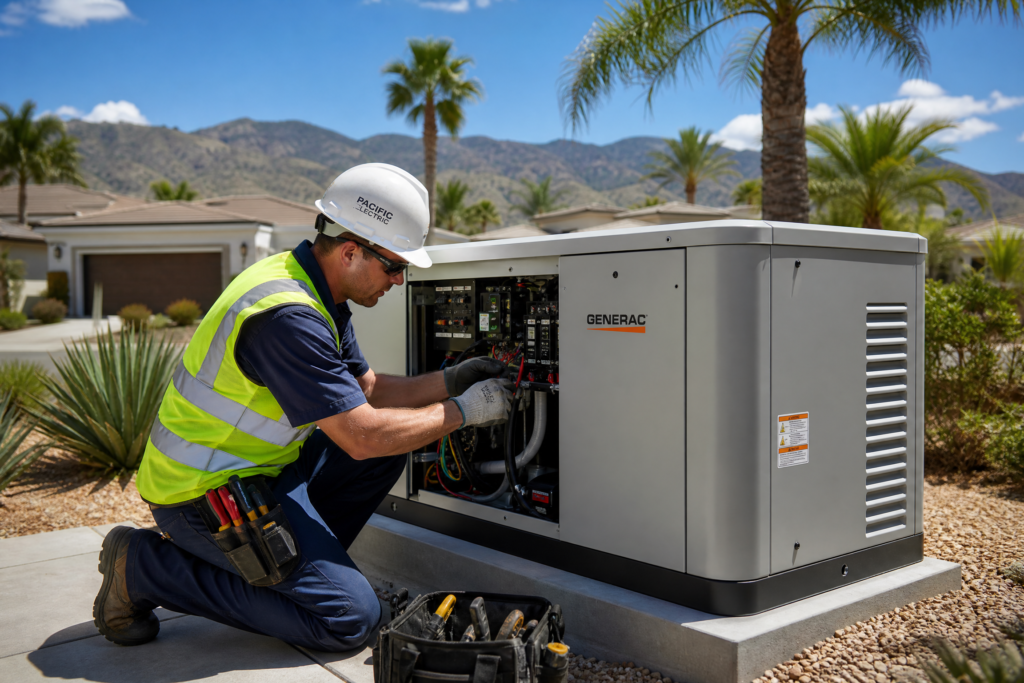
Licensed San Diego County electrical contractor for standby & whole house generator installation. Permits, Generac installs, repairs, and maintenance near
If you have ever lost power during a Santa Ana wind event, a summer heat wave, or one of San Diego Gas & Electric’s Public Safety Power Shutoffs (PSPS), you already know what is at stake. Refrigerated medication goes bad. Wine cellars warm up. Home offices disconnect mid-meeting. Server rooms crash. For families that work from home, for restaurants in Chula Vista, and for medical practices in La Jolla, an outage is more than an inconvenience — it is a real risk.
That is why more property owners across San Diego County are calling a licensed electrical contractor for backup generator installation than at any point in the last decade. This guide walks you, in plain language and from the perspective of someone who has pulled hundreds of generator permits in this region, through exactly what professional generator installation in San Diego County looks like — from sizing and selection to permits, inspections, costs, and long-term maintenance.
Why San Diego County Homes and Businesses Need a Standby Generator
San Diego County stretches from the surf in Del Mar to the wild backcountry near Fallbrook, and each microclimate has its own reliability problem.
Public Safety Power Shutoffs and Wildfire Threats
Every fall, SDG&E proactively shuts off circuits in high-fire-risk zones — parts of Rancho Bernardo (92127, 92128), Poway (92064), Scripps Ranch, and the rural hills east of Fallbrook (92028). These PSPS events can last anywhere from a few hours to several days. An automatic standby generator wired to your electrical panel will pick up that load in under ten seconds. You will never know the grid went down.
SDG&E Grid Stress During Heat Waves
Inland communities like El Cajon (92020), Santee (92071), and San Marcos (92069) routinely hit triple-digit temperatures in July and August. When the whole neighborhood cranks the AC at once, substation transformers overheat and circuits trip. A whole house generator installation sized correctly for your AC compressor, kitchen, and home office eliminates this risk.
Coastal Fog, Salt Air, and Electrical Wear
Closer to the coast — La Jolla (92037), Del Mar, Carmel Valley (92130), and Carlsbad (92011, 92009) — salt-laden air accelerates corrosion on outdoor electrical equipment. A licensed electrical contractor specifies corrosion-resistant enclosures, weather-tight conduit, and marine-grade fittings to keep these coastal installations reliable for years.
In every corner of the county, backup generator installation is no longer a luxury. It is becoming standard infrastructure for any property owner who wants to maintain comfort, safety, and business continuity.
How a Licensed Electrical Contractor Approaches a Generator Installation (Step-by-Step)
Professional generator installation is not a one-day job done by a handyman. It is a multi-week process with electrical and building permits, engineering calculations, gas-line coordination, and final commissioning. Below is exactly how a licensed electrical contractor handles it.
Step 1: In-Home Load Assessment and Sizing
We start at your electrical panel with a clip-on ammeter and a load-listing worksheet. We add up the actual running wattage of your HVAC compressor, kitchen appliances, well pump, EV charger, and the circuits you specifically want backed up (lighting, fridge, internet, medical equipment). This determines whether you need an essential-circuit generator (typically 8–14 kW) or a full whole house generator installation (typically 22–26 kW for a 3,000 sq ft San Diego home).
Step 2: Choosing the Right Automatic Standby Generator
Most homeowners in San Diego County end up with a Generac automatic standby generator. Generac units dominate the market because the dealer network, parts availability, and warranty service are reliable in our region. That said, a good generator electrician will evaluate your home’s natural gas supply, available gas pressure at the meter, and your preferred noise profile before recommending a specific model. We also frequently install Kohler and Briggs & Stratton units when the homeowner has a brand preference.
Step 3: Securing the Generator Permit in the Correct Jurisdiction
This is where many homeowners get tripped up. San Diego County is patchwork of jurisdictions:
- City of San Diego issues electrical permits through Development Services.
- Carlsbad, Encinitas, San Marcos, Poway, Escondido, Vista, Oceanside, Chula Vista, National City, El Cajon, Santee, La Mesa, and Imperial Beach each issue their own permits.
- The County of San Diego Building Services handles everything in the unincorporated areas (Fallbrook, Ramona, Alpine, Valley Center, Lakeside, Spring Valley, Jamul).
A licensed electrical contractor pulls the generator permit under our contractor’s license. Application fees for residential standby generators typically fall between $175 and $540 depending on the jurisdiction and whether gas piping is included. Commercial projects are quoted by valuation and plan-check.
Step 4: Site Prep, Gas Line, and Clearances
The generator sits on a poured concrete pad or composite mounting base with manufacturer-specified clearances from the home, property line, windows, and openings (typically 18 inches from the structure, 5 feet from openings, and noise-rated setbacks per local ordinance). We coordinate with a licensed plumbing contractor to extend your natural gas line or LP gas line to the unit. Setback, noise, and exhaust locations are checked against the local zoning rules — Carlsbad and Encinitas are especially strict on sound.
Step 5: Electrical Panel Upgrade and Transfer Switch Wiring
Often, the existing 200 amp main panel does not have enough breaker space for the new transfer switch sub-panel. That is when an electrical panel upgrade is bundled into the same permit. A new transfer switch (ATS — automatic transfer switch) is installed beside your main panel and wired to the circuits you selected. When utility power drops, the ATS signals the generator to start, transfers the load, and keeps everything running until utility power is restored.
Step 6: Setting the Generator and Electrical Rough-In
We set the generator on the pad, connect the gas line, run the low-voltage control wiring, and connect the line-voltage feeders back to the ATS. If you have an older fuse panel or Zinsco or Federal Pacific panel — both of which we still see in 1960s–70s La Jolla, Clairemont, and Kearny Mesa homes — a full electrical panel upgrade is almost always required to safely handle a modern transfer switch and standby load.
Step 7: Final Inspection, Commissioning, and Owner Orientation
The building department inspector (or the fire district inspector in some wildland-urban-interface zones) signs off on the electrical and gas work. The gas company comes out to verify pressure. We start the unit under load, simulate a power outage with the homeowner watching, and walk you through the controller, mobile app, and weekly self-test cycle. Once everything is documented and the permit is finalized, your generator is ready for whatever the next Santa Ana event throws at it.
Residential Generator Installation vs. Commercial Generator Installation
The electrical contractor playbook differs depending on whether the property is a single-family residence, a multi-unit dwelling, or a commercial facility.
Whole House Generator Installation for Larger Homes
Most San Diego homeowners in 92127, 92128, 92130, 92064, and 92130 opt for a whole house generator installation that covers the entire main breaker panel. This delivers seamless protection without any circuit-by-circuit thinking during an outage.
Partial-Home and Essential-Circuit Installations
For condos, smaller homes in 92109, older 92024 Encinitas bungalows, or homes on tighter gas-meter capacities, an essential-circuit sub-panel backed by an 8–14 kW unit is often the more practical answer. This keeps the fridge, internet, a few lighting circuits, and one small AC zone online without overspending on capacity you will not use.
Light Commercial Backup for Restaurants, Clinics, and Small Offices
As a commercial electrical contractor, we also work with restaurant operators in Carlsbad (92008), medical and dental clinics in Carmel Valley (92130), small manufacturers in Otay Ranch (91915) and Eastlake (91914), and professional offices across the county. Commercial generator installation typically involves three-phase power, commercial fire and life-safety integration, larger 30 kW–150 kW units, and more involved plan checks with the building official.
San Diego County Generator Permits, Inspections & Code Compliance
Permitting is the part most homeowners underestimate. Each jurisdiction is slightly different, and a licensed electrical contractor who has done this work locally knows exactly what each reviewer wants to see.
City of San Diego Development Services
For properties inside city limits — including La Jolla (92037), Carmel Valley (92130), Rancho Bernardo (92127, 92128), Mira Mesa, Kearny Mesa, Pacific Beach, Clairemont, and Scripps Ranch — the City of San Diego’s Development Services Department handles the electrical permit. Generator-only installations typically require a single electrical permit, with a fee in the range of $150–$350 depending on scope.
County of San Diego Building Services (Unincorporated Areas)
If your property is in the unincorporated county — Fallbrook (92028), Valley Center, Ramona, Alpine, Lakeside, Spring Valley, Jamul, or the backcountry areas — the County of San Diego Building Services Division issues the permit. Inspections are scheduled through the same office.
North County Cities
For Carlsbad (92008, 92009, 92011), Encinitas (92024), San Marcos (92069, 92078), Poway (92064), Escondido (92025, 92026, 92027), and Vista (92081, 92083, 92084), each city has its own Community Development or Building Department. As a local contractor we permit in each of these every week and know the local reviewers by name.
East County Cities
El Cajon (92020, 92021), Santee (92071), La Mesa (91941, 91942), Lemon Grove (91945), and Lakeside each maintain their own building departments. These jurisdictions are usually fast to issue same-day generator permits for straightforward installations.
South County Cities
Chula Vista (91910, 91911, 91913, 91914, 91915), National City (91950), Imperial Beach (91932), San Ysidro (92173), and the Otay Ranch and Eastlake master-planned communities in 91914 and 91915 each process their own residential and commercial generator permits.
SDG&E Interconnection and Rule 21
Standby generators that never export power back to the grid do not typically require an interconnection agreement. However, if a customer installs a bidirectional system or a combined solar-plus-storage-plus-generator setup, SDG&E’s Electric Rule 21 process is triggered and an interconnection application must be filed. As your licensed electrical contractor, we coordinate this paperwork directly.
Air Quality, Setbacks, and Noise Considerations
The San Diego County Air Pollution Control District (APCD) and South Coast Air Quality Management District (AQMD) both have rules for stationary engines. Generators above 50 brake horsepower may require an AQMD permit. In addition, every California installation must comply with the manufacturer’s specified setbacks from windows, doors, and openings — typically 18 inches from a wall and 5 feet from any opening.
Generator Maintenance, Repair & Inspection Schedule
Buying a standby generator is one decision. Keeping it ready is another. As a licensed electrical contractor offering ongoing service plans, here is what we recommend.
Weekly and Monthly Self-Tests
Modern Generac automatic standby generators run a weekly self-test on a schedule you set. This circulates oil, brings the engine up to operating temperature, and exercises the transfer switch. We recommend a 20-minute weekly cycle under at least 30% load for San Diego installations.
Annual Professional Maintenance
Twice-yearly professional maintenance is the industry gold standard, with one service scheduled before fire season (August) and another mid-winter. An annual inspection covers oil and filter changes, spark plug replacement, valve adjustment on larger units, battery testing, controller firmware updates, fuel-pressure verification, and a full simulated outage.
Generator Repair Warning Signs
If you notice hard starting, slow transfer, visible fuel leaks, soot on the exhaust side of the unit, controller fault codes that repeat weekly, or a battery that fails load test, it is time for generator repair. We staff a small fleet of service vans specifically for homeowners who bought their units elsewhere and need a competent emergency electrician to come diagnose the problem.
Generator Installation Cost in San Diego County: Real-World Ranges
In 2026, a professionally installed residential standby generator in San Diego County typically falls between $9,000 and $25,000 turnkey. Commercial installations run anywhere from $25,000 for a small three-phase unit to well over $100,000 for restaurant, healthcare, or data-grade backup.
What Drives the Final Price
- Generator capacity (kW rating)
- Distance from existing gas meter
- Need for an electrical panel upgrade
- Setback, site prep, and concrete work
- Permit fees in the specific jurisdiction
- Trenching for gas and electrical runs in larger properties
- Sound-attenuating enclosures in noise-sensitive neighborhoods
Typical Turnkey Price Ranges (2026)
- 8–14 kW essential-circuit install: $9,000–$13,000
- 18–26 kW whole house installation: $13,000–$22,000
- 30–48 kW light commercial: $25,000–$60,000
- 60 kW+ commercial with paralleling switchgear: $60,000+
These are real ranges pulled from recent San Diego County jobs; your specific quote will depend on the variables above. We will always provide a written, line-itemized estimate before any work begins.
Common Mistakes San Diego Property Owners Make With Backup Generators
After two decades in this trade, here are the mistakes we see most often:
- Hiring an unlicensed handyman to wire a transfer switch — this voids the manufacturer’s warranty, fails inspection, and creates a fire risk.
- Skipping an electrical panel upgrade because “the existing panel looked fine” — older Zinsco or Federal Pacific panels cannot safely handle modern standby loads.
- Sizing the generator too small to start the AC compressor under locked-rotor amps.
- Placing the unit too close to a bedroom window — violating setback and noise rules.
- Forgetting to schedule annual generator maintenance until after the first PSPS event.
- Using the wrong gas pipe sizing for units above 22 kW.
- Failing to coordinate SDG&E Rule 21 paperwork for solar-plus-generator hybrids.
A licensed electrical contractor avoids all of these on your behalf — that is what you are paying for.
Service Areas Across San Diego County
We provide electrical contractor generator installation in San Diego County across these ZIP codes and neighborhoods:
- 92127, 92128 — Rancho Bernardo, 4S Ranch, Del Sur
- 92130 — Carmel Valley, Del Mar Mesa, Pacific Highlands Ranch
- 92064 — Poway, Green Valley
- 92069 — San Marcos, San Elijo Hills
- 92078 — San Marcos (south), Discovery Hills
- 92024 — Encinitas, Cardiff-by-the-Sea, Leucadia
- 92009, 92011 — Carlsbad (south and La Costa), Aviara
- 92037 — La Jolla, Bird Rock, UTC
- 92071 — Santee, Carlton Hills
- 92020 — El Cajon, Bostonia
- 91914, 91915 — Eastlake, Otay Ranch, Millenia
- 92028 — Fallbrook, Rainbow
If your ZIP code is not listed, we likely still cover it. Call us to confirm coverage for your specific address.
Frequently Asked Questions About Generator Installation in San Diego County
1. Do I really need a permit for a home generator installation in San Diego County?
Yes. Every jurisdiction in the county — the City of San Diego, the County of San Diego, Carlsbad, Encinitas, Poway, El Cajon, Santee, San Marcos, Escondido, Vista, Chula Vista, and all other cities — requires an electrical permit and sometimes a separate plumbing/mechanical permit for the gas line. A licensed electrical contractor pulls these for you.
2. How long does a typical residential standby generator installation take from contract to first run?
Most turnkey installations take 3–6 weeks: one week for assessment and design, one to two weeks for permit issuance, and one to two days for the actual installation plus inspection.
3. What size standby generator do I need for a 2,500 sq ft San Diego home?
For a typical 2,500 sq ft single-family home with central AC, expect a 18–22 kW unit for whole-house coverage or 10–14 kW for essential-circuit only. A proper load calculation by a licensed electrical contractor will confirm.
4. Can I install a Generac generator myself?
Generac requires that an authorized installer handle warranty work. Beyond warranty concerns, electrical work in California must be performed by a licensed electrical contractor under C-10 license to be lawful and insurable.
5. Do standby generators require SDG&E approval?
Standby units that never export back to the grid generally do not require an interconnection agreement. Solar-plus-storage-plus-generator systems do. We handle the Rule 21 paperwork when triggered.
6. How often does my standby generator need maintenance?
Weekly automatic self-tests plus professional service every 6–12 months. Annual generator maintenance includes oil, filters, spark plugs, battery test, controller updates, and a simulated outage.
7. What is an automatic standby generator?
It is a permanently installed generator paired with an automatic transfer switch that senses utility outages, starts the engine, and transfers electrical loads automatically — no manual intervention required.
8. Can a generator power my entire house including the AC?
Yes, when properly sized. A whole house generator installation covers every circuit in your main panel, including central air conditioning.
9. Will my homeowner’s insurance discount the premium for a standby generator?
Some carriers do. We recommend calling your insurer after installation and asking about emergency power solutions credits.
10. What is the difference between a portable and a standby generator?
A portable generator is rolled out, manually wired, and run on gasoline. A standby generator is permanently installed, automatic, and fueled by natural gas or propane — much safer, cleaner, and more reliable.
11. Do I need an electrical panel upgrade when installing a generator?
If your existing main panel is full or older (Zinsco, Federal Pacific, or 100 amp service), an electrical panel upgrade is often bundled with the generator installation to give the transfer switch a proper home and maintain safety margins.
12. How loud is a standby generator?
Modern Generac and Kohler units run between 60 and 70 decibels at 23 feet — comparable to a central AC condenser. Our team helps you place the unit to meet local setback and noise ordinances.
13. Do you handle emergency repairs if my generator fails during a PSPS event?
Yes. We staff an emergency electrician line for active outages. If your generator is down during a shutoff, call us and we will route a technician as soon as conditions are safe.
14. Can you service a generator another company installed?
In almost every case, yes. We routinely provide generator repair and maintenance on units installed by other contractors, including older Generac, Kohler, and Briggs & Stratton systems.
Conclusion + Strong Call to Action
If you live in San Diego County — whether that means coastal La Jolla, the inland heat of El Cajon, the master-planned communities of Eastlake and Otay Ranch, or the canyons around Fallbrook — having a professionally installed standby generator is one of the smartest investments you can make in your property. It protects your family during PSPS events, keeps your business open during grid outages, and adds measurable resale value to your home.
The work is too important to hand to anyone other than a licensed electrical contractor with deep local permit experience, strong manufacturer relationships, and a service team that answers the phone when you actually need them.
Call us today for a free in-home generator assessment and a written, line-itemized quote. We will come to your home, walk the property with you, do a real load calculation, and lay out your options for backup generator installation, automatic standby generator, whole house generator installation, or commercial-grade emergency power solutions. Whether you need a new Generac generator installer or a service plan for the unit you already own, you will talk to a real licensed electrical contractor — not a call center.
- /residential-electrical-services-san-diego-county
- /commercial-electrical-services-san-diego-county
- /electrical-panel-upgrade-san-diego
- /generator-repair-and-maintenance-san-diego
- /sdge-rule-21-interconnection-guide
- /blog/what-size-generator-do-i-need
- /blog/title-24-and-standby-generators
- /contact-us
- /service-areas